3.6.1A New Harmonic Grammar
In 1964, a twenty-one-year-old guitarist from Seattle plugged into an amplifier, turned every knob to ten, and played a chord that contained five notes - all from the minor pentatonic scale, all moving in parallel, all breaking every rule of classical voice leading simultaneously. The sound was enormous, filthy, and magnificent. It was also, from a theoretical perspective, completely unexplainable by the tools we have built so far.
Throughout Unit II and the early chapters of Unit III, we have examined harmony through the lens of functional relationships. Chords act as agents: they push, pull, resolve, and embellish. But rock music, heavily influenced by the blues and the electric guitar, invented a completely different way of treating chords. We first encountered the pentatonic scale in Chapter 1.4, where it seemed like the simplest possible scale - just five notes, no semitones, no tension. But simplicity, as we are learning throughout this book, is not the same as weakness. The pentatonic scale’s very lack of semitones means it lacks the leading tone - the gravitational pull of 7̂→8̂ that powers the Authentic Paradigm (Chapter 2.4). Without that pull, pentatonic harmony must find other ways to establish home. What it finds is something radical.
This process is called parallel pentatonicism. It occurs when a composer takes a pentatonic scale and builds a similar chord - usually a major triad or a power chord (an empty fifth) - on each step of that scale.
The resulting chords are not functionally related. They do not follow the rules of classical voice leading, nor do they seek to resolve to one another in traditional cadences. Instead, they act as massive, thickened melodies. The entire chord structure moves in parallel, dragging its weight up and down the pentatonic scale.
This is a profoundly different way of organizing sound. In parallel pentatonicism, harmony is non-functional, and voice leading is severely compromised. All voices tend to move in strictly parallel motion.
3.6.2Minor Pentatonic Doubling
The most common form of this technique is minor pentatonic doubling.
The minor pentatonic scale consists of five notes: 1, ♭3, 4, 5, and ♭7. If we build a major chord on each of these notes, we get the following chords: I, ♭III, IV, V, and ♭VII.
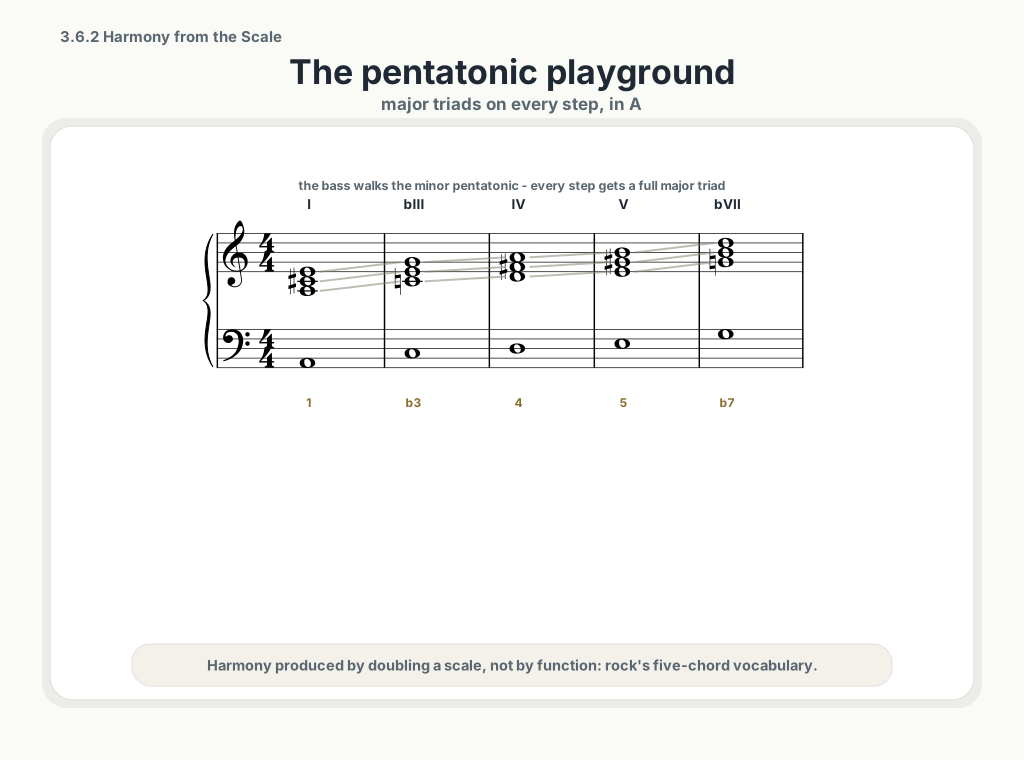
Because these chords are generated by doubling a scale rather than by functional syntax, groups like I–♭III–♭VII–I and I–♭III–IV–I are functionally equivalent. They are simply different melodic paths through the same pentatonic playground.
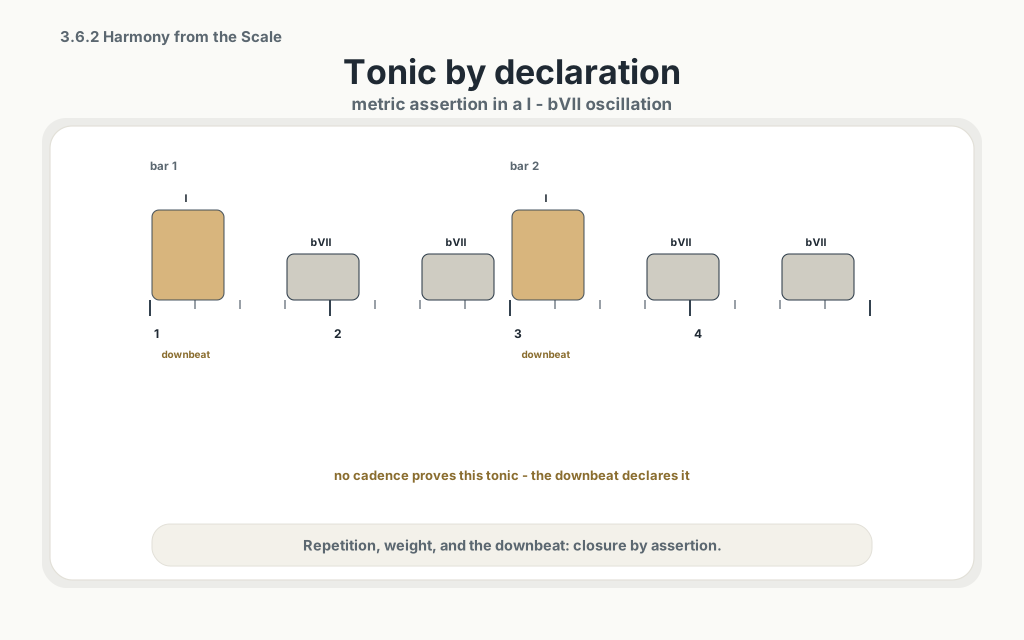
Tonic status in this system is not established by a V–I cadence. Instead, the tonic is established by metric assertion (playing it on the strong beat), by repetition, and by neighbour motions. This is a profoundly different closural logic. In the language of the Closure Thesis (Chapter 2.3), parallel pentatonicism operates through what we might call metric closure or assertive closure - tonic is not proven by dominant function but declared by rhythmic weight and repetition. This is closer to the logic of a West African drum ensemble or an Indian drone than to a Bach chorale. It is another demonstration that closure is graded and style-dependent, not universally governed by V–I syntax.
The Sage
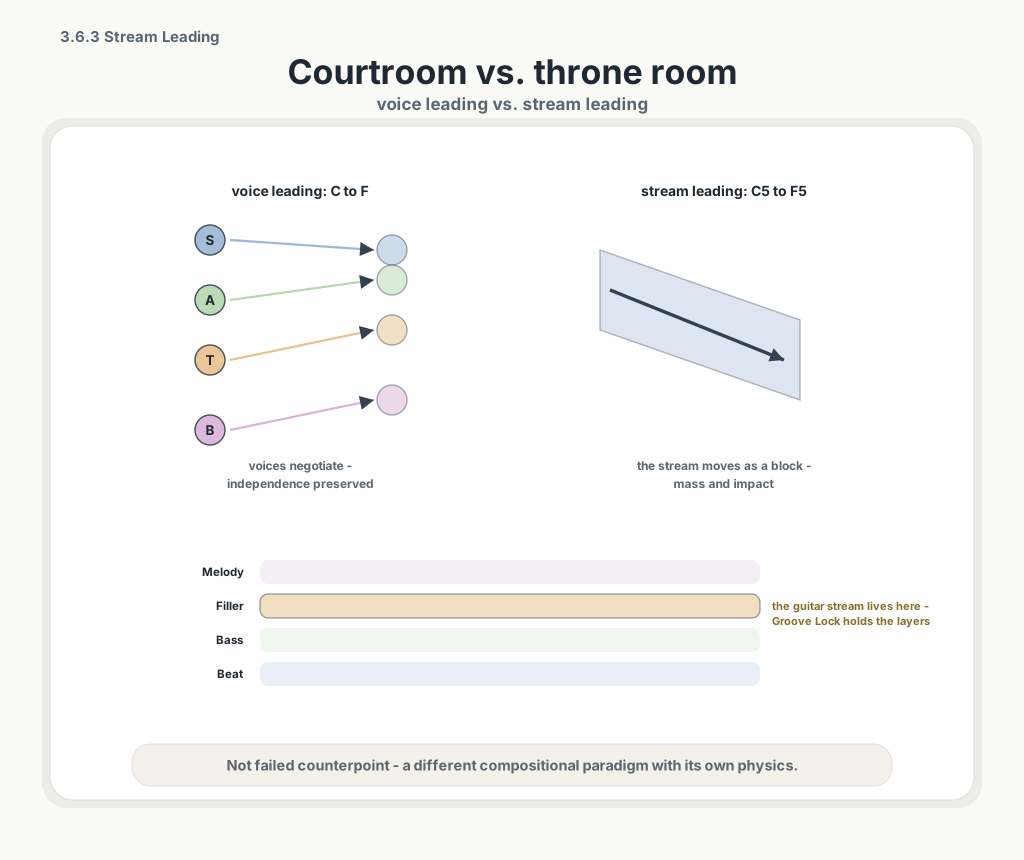
“There is a profound philosophical shift here. In functional harmony, the tonic earns its authority through argument - the dominant proves, the tonic concludes. In pentatonic harmony, the tonic earns its authority through presence - it is there, it is loud, it is on the downbeat, and that is enough. One system is a courtroom. The other is a throne room.”
Example: The Who’s My Generation establishes its tonic simply by oscillating between I and ♭VII. In the 1960s, soul and R&B artists frequently alternated these pentatonic chords over a stationary tonic bass pedal, as heard in The Drifters’ On Broadway and Stevie Wonder’s “Uptight (Everything’s Alright).”
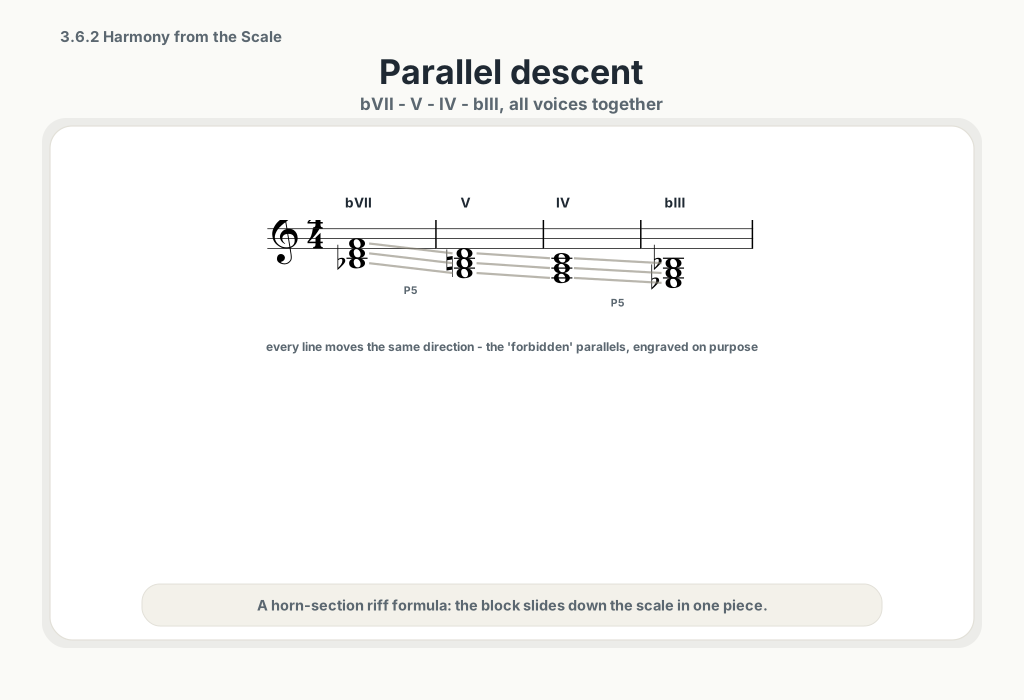
The pentatonic nature of blues-based rock was perhaps most loudly announced by the Stax Records house band in Memphis. The iconic horn introduction to Wilson Pickett’s In the Midnight Hour consists of parallel major triads descending the minor pentatonic scale: ♭VII – V – IV – ♭III. This aggressive, parallel descent immediately establishes a blues-rock vocabulary before the song locks into its major-mode verse.
The pentatonic grammar extends well beyond classic rock. In hip-hop, the RZA’s production for Wu-Tang Clan draws on minor pentatonic chord movement filtered through lo-fi sampling, creating a gritty, modal harmonic language. In modern R&B, Frank Ocean’s Pyramids shifts between pentatonic chord blocks, using metric assertion rather than cadential resolution to establish tonal centres. And in electronic music, Daft Punk’s Around the World is essentially a single pentatonic riff harmonized with parallel chords over an unchanging groove - Stream Leading as dance music philosophy.
3.6.3Stream Leading vs. Voice Leading
Parallel pentatonicism is a perfect illustration of Stream Leading - a concept we introduced in Chapter 2.1.
In traditional SATB (Soprano, Alto, Tenor, Bass) voice leading, independent voices move carefully to avoid parallel fifths and octaves, seeking contrary motion to preserve their independence.
But in a heavy rock riff like Nirvana’s Smells Like Teen Spirit or Living Colour’s Cult of Personality, the guitar is not playing four independent voices. It is playing a single, thickened “stream” of sound. The power chords (root and fifth) slide up and down the guitar neck in strict parallel motion.
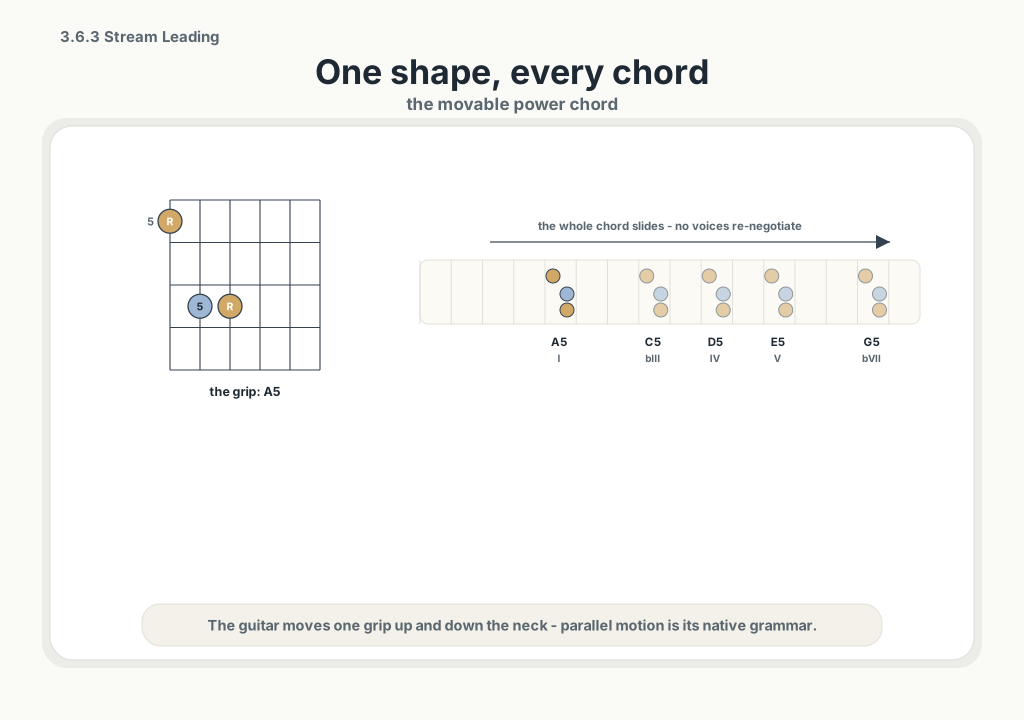
The goal is not contrapuntal independence; the goal is mass and impact. The harmony has been subordinated to the riff. The stream moves as a single, unified block, locking into the groove of the rhythm section.
This is Stream Leading in its purest form - the concept we formalized in Chapter 2.1. Recall the four functional layers: Beat, Bass, Filler, and Melody. In parallel pentatonicism, the Filler stream (the guitar’s power chords) has abandoned any pretence of independent voice leading. It moves as a block, a thickened melody, sliding along the pentatonic scale. Meanwhile, the Beat stream (drums) and the Bass stream maintain their own rhythmic logic, creating Groove Lock - the interlocking of independent streams that produces the composite feel. The result is not poor counterpoint; it is a different compositional paradigm, one where mass and impact replace independence and resolution.
Prof. Krankenhorn
“Parallel fifths. Parallel fifths everywhere. I have counted no fewer than fourteen consecutive parallel fifths in ‘Smells Like Teen Spirit.’ Palestrina is turning in his grave.”
The Craftsman
“Palestrina is resting peacefully, Professor. Cobain wasn’t writing a motet. He was building a wall of sound, and the parallel fifths are the bricks.”
3.6.4Aeolian Doubling
A slightly more complex variation is Aeolian doubling. This occurs when a grouping of four major chords - I, ♭III, IV, and ♭VI - is used together.
On paper, this looks like a progression drawn from the Aeolian mode (the natural minor scale). However, the underlying logic is still pentatonic. The ♭VI chord is introduced to create an interlocking pattern of minor thirds and perfect fourths.
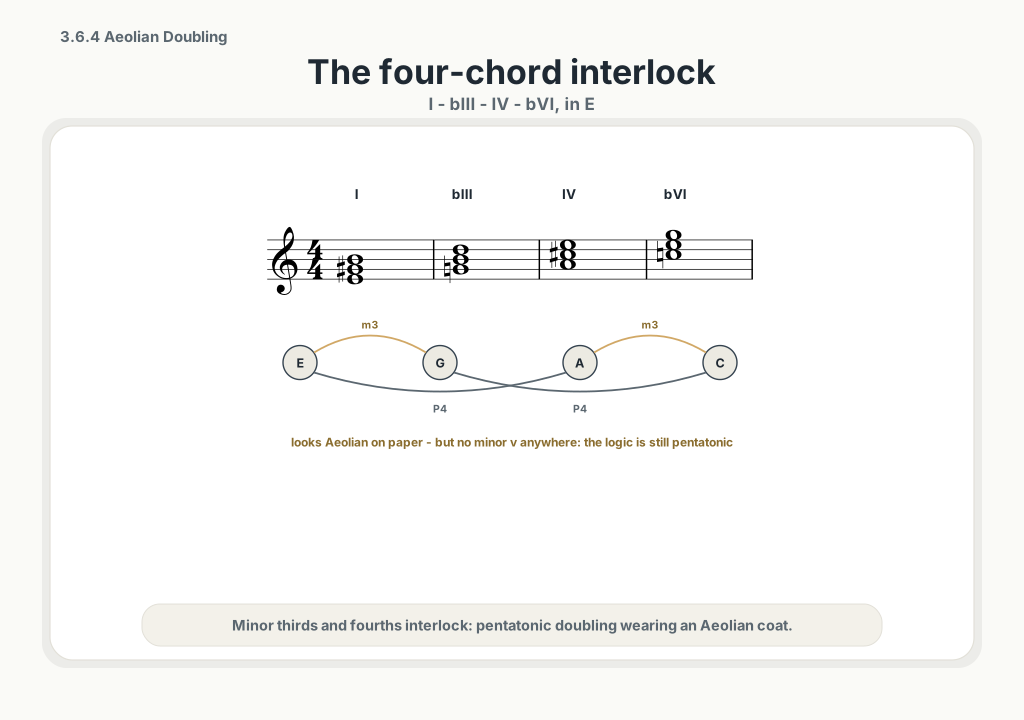
This creates a blues-like effect, but it often admits a bit more counterpoint than strict minor pentatonic doubling. The bass might rise while an inner voice descends, creating a richer texture that still defies classical functional analysis.
Example: The Monkees’ “I’m Not Your Steppin’ Stone” uses the exact progression I – ♭III – IV – ♭VI – I. The Knack’s My Sharona and Nirvana’s Smells Like Teen Spirit also rely on this specific Aeolian-inflected pentatonic grouping. Note that a true Aeolian progression in classical music would typically require a minor dominant (v) chord, which has no place in these aggressive, major-chord-driven rock riffs.
3.6.5Ionian and Other Doublings
While minor pentatonic doubling is the rock standard, composers occasionally apply the same parallel doubling technique to other scales, often with surreal or disorienting results.
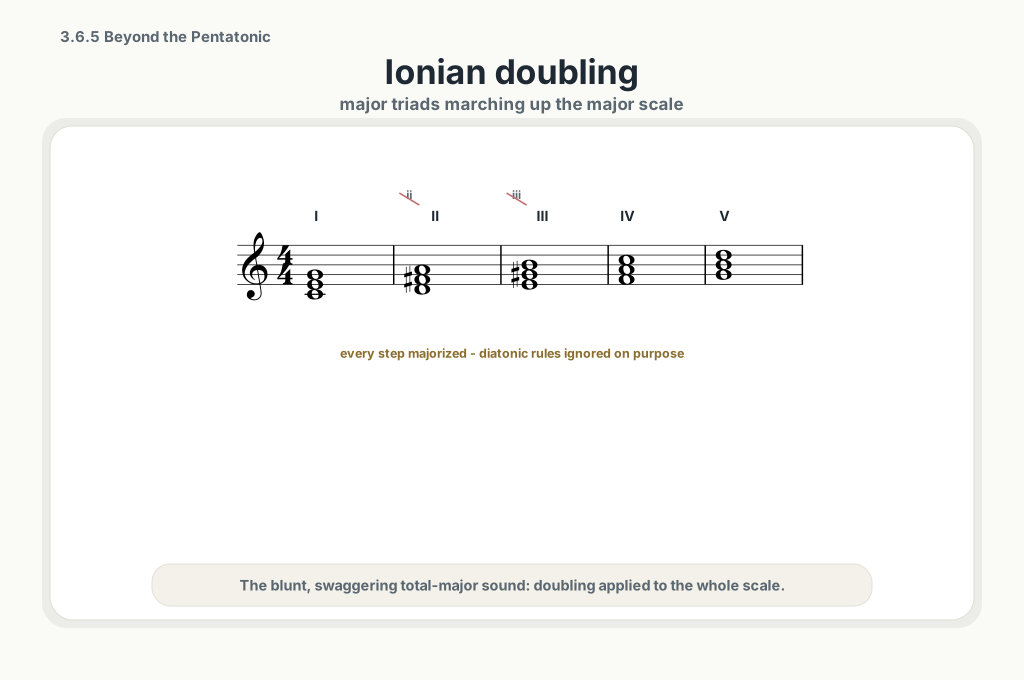
Ionian Doubling: Jim Croce’s Bad, Bad Leroy Brown features a pugilistic, major-triad doubling of the major (Ionian) scale: I – II – III – IV – V. Every step of the scale is harmonized with a major chord, creating a blunt, swaggering effect that completely ignores diatonic rules.
Aeolian Major Doubling: The Beatles’ I Am the Walrus features deliciously ludicrous chords that result from building a major triad on every note of the descending Aeolian scale. The result is a bizarre, shifting harmonic landscape that perfectly matches the song’s psychedelic lyrics.
The Traveller
“I once asked a West African griot why his kora accompaniment moved in parallel thirds. He looked at me as if I had asked why water runs downhill. ‘Because that is where my fingers go,’ he said. Parallel motion is not an aberration of voice leading. For most of the world’s musicians, it is the natural state of harmony - the thing you do before anyone tells you to do something else.”
3.6.6The Limits of the Pentatonic System
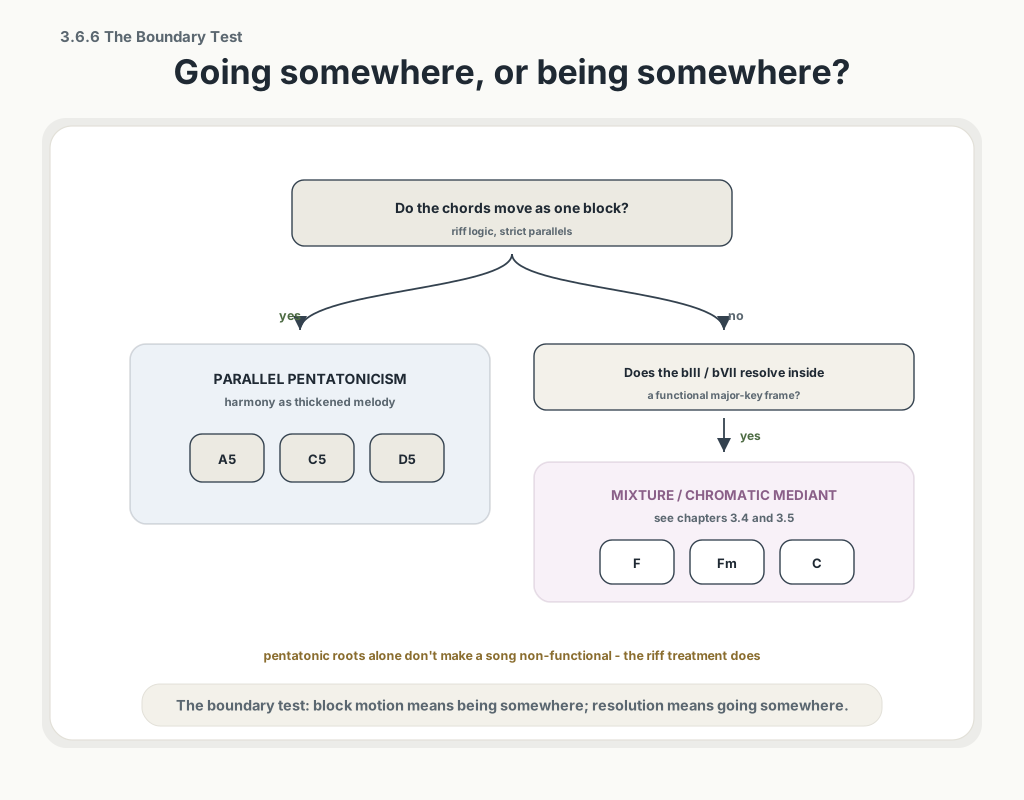
It is important to note that just because a song uses chords with roots that fit a pentatonic scale, it does not automatically mean the song has abandoned tonal tradition.
Many pop songs use a ♭III or a ♭VII chord as a colourful, momentary departure (a chromatic mediant or a modal mixture) within a functional, major-key framework. The hallmark of true parallel pentatonicism is the riff - the treatment of the chords as a single, sliding block of sound that ignores functional resolution in favour of groove and melodic motion.
When listening to a progression, ask yourself one question: are these chords going somewhere, or are they being somewhere? Are they independent agents with agendas, or are they a single, thickened melody sliding along the fretboard like a freight train on rails? If it is the latter - if the harmony has stopped negotiating and started marching - you are hearing parallel pentatonicism. And you are probably also hearing an electric guitar turned up very, very loud.
The rhythmic dimension of parallel pentatonicism - the way riffs create their own micro-form through repetition and groove - will take on new significance in Chapter 4.7 (Advanced Rhythm and Meter), where we explore how rhythmic patterns can generate formal structure independently of harmonic progression. And the broader question of non-functional harmony - chords that exist for colour and mass rather than syntactic function - will recur throughout Unit IV, particularly in Chapter 4.6 (Equal Division of the Octave), where symmetrical scales generate harmony that defies functional classification entirely.
Parallel pentatonicism is, in the end, a reminder that harmony did not begin with Bach. Before there were voice-leading rules, there were voices - singing together, moving together, thickening a melody into something more than one person could produce alone. The pentatonic scale is the oldest harmonic resource on earth. That it still powers the most visceral, physical music of the twenty-first century is not a failure of progress. It is a testament to the scale’s elemental truth.