Ear First - this chapter's listening
Cue a few of these before you read. The argument lives in your ears, not on this page.
La Bamba - Los Lobos Twist and Shout - The Beatles Johnny B. Goode - Chuck Berry Louie, Louie - The Kingsmen I Will Survive - Gloria Gaynor Let It Be - The Beatles Yellow - Coldplay Brown Eyed Girl - Van Morrison Autumn Leaves - Chet Baker
2.4.1The Primary Triads
Every key has its aristocracy.
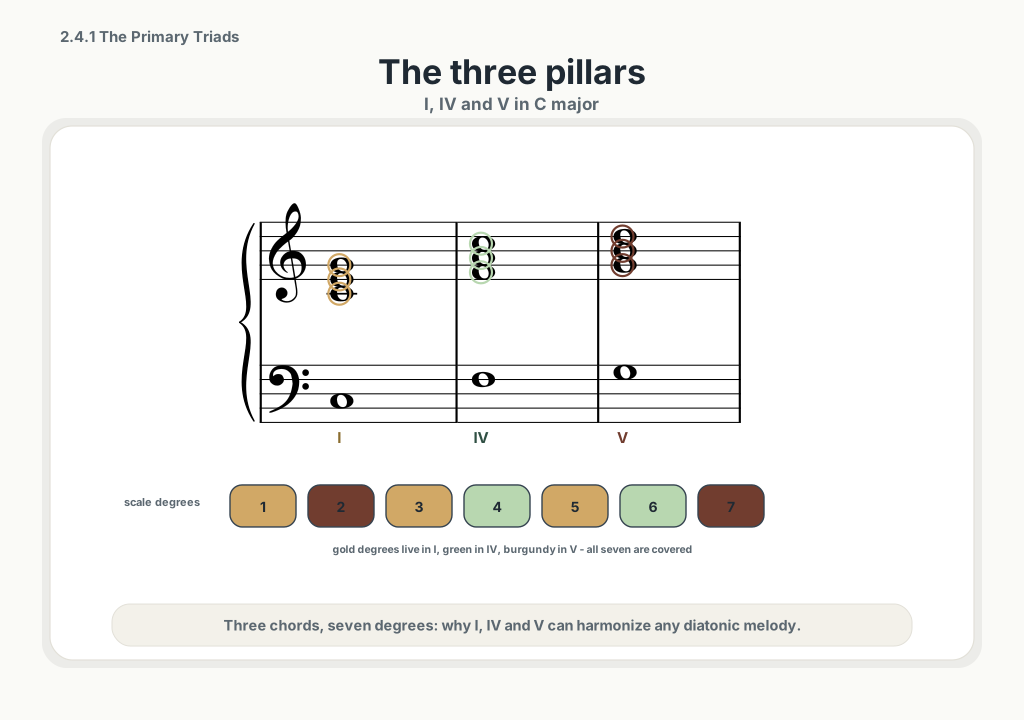
Out of the seven diatonic triads - the seven chords that can be built from a major scale using only the notes of that scale - three occupy a different stratum entirely. They are the primary triads: the chords built on the first, fourth, and fifth degrees. In Roman numerals: I, IV, and V. In the key of C major: C, F, and G.
What makes them primary is not arbitrary convention. It is a mathematical fact with enormous musical consequences: between them, the I, IV, and V chords contain every note of the diatonic scale. In C major, the I chord gives you C, E, and G. The IV chord gives you F, A, and C. The V chord gives you G, B, and D. Seven distinct pitches across three chords - the entire scale, captured. This means that any melody you can write in a given key can, in principle, be harmonized using only these three chords. Three chords and the truth, as the Nashville saying goes.
And people have been proving that saying right for centuries. La Bamba. Twist and Shout. Johnny B. Goode. “Wild Thing.” Louie, Louie. The twelve-bar blues. Thousands upon thousands of folk songs, hymns, country ballads, punk anthems, and campfire singalongs - all built from the same three harmonic pillars. These songs are not simple because their creators lacked sophistication. They are simple because the relationships between I, IV, and V are so powerful, so deeply satisfying, that they need no ornamentation. The engine runs on three cylinders and it runs beautifully.
Each primary triad has a function - a role it plays in the drama of a key.
The tonic (I) is home. Rest. Stability. The place where tension dissolves, where the musical sentence lands, where the listener’s ear settles and says: yes, this is where we are. Every other chord in the key is defined, in part, by its relationship to the tonic - how far from home it sits, and how strongly it pulls back.
The subdominant (IV) is departure. It steps away from the tonic, introduces new harmonic colour, opens a space. The IV chord shares a note with the tonic (in C major, both C and F chords contain C), and that common tone gives the departure a gentle quality - a leave-taking that remembers where home is.
The dominant (V) is tension. It demands return. The V chord contains the leading tone - the seventh degree of the scale, sitting one precarious half step below the tonic - and that leading tone is a leash, a gravitational cord, a note that leans so hard toward home that it can barely stand still. The dominant is the chord of expectation. It says: something is about to happen.
These three functions - rest, departure, tension - are the fundamental grammar of tonal harmony. They are the subject, the verb, and the object of the harmonic sentence. And they set the stage for the argument this chapter is about to make.
2.4.2The Authentic Paradigm (V–I)
The relationship between the dominant and the tonic is the most celebrated motion in Western music theory. It has been analyzed, codified, venerated, and taught as the supreme law of harmonic resolution for three centuries. In common-practice tonality - the harmonic language of Bach, Mozart, Beethoven, and their descendants - the V–I cadence is the gold standard of closure. The final handshake. The period at the end of the sentence. The door closing behind you as you arrive home.
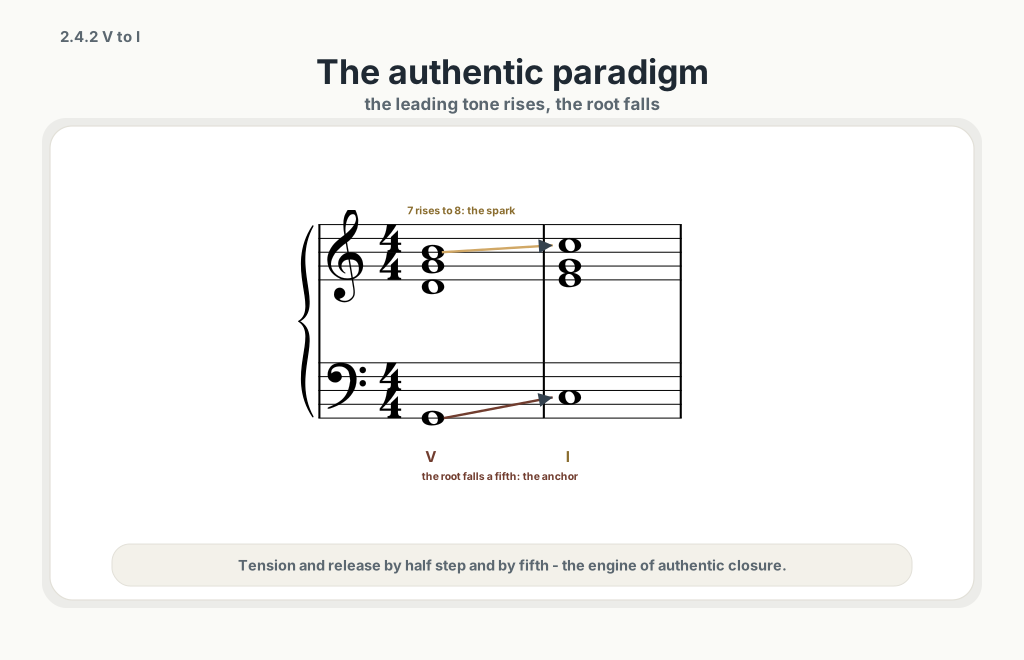
There are good reasons for this. The V–I motion is driven by some of the most powerful forces in tonal music, all converging simultaneously:
The leading tone resolves upward by half step to the tonic - the smallest possible distance, creating maximum gravitational pull. The root movement descends by a fifth (or ascends by a fourth), which is the strongest directional motion available in the diatonic system. And the common tone - scale degree 5, shared by both the V and the I chord - holds steady, providing continuity across the resolution. Tension, direction, connection: all at once.
This is the Authentic Paradigm, and its power is undeniable. Listen to the ending of virtually any Mozart sonata, any Beethoven symphony, any Bach chorale. V to I. The engine of classical harmony. When a classical composer needed to say we are done, we have arrived, the journey is over, this was the gesture that said it.
In popular music, the Authentic Paradigm drives songs forward with an urgent, goal-directed energy. La Bamba cycles through I–IV–V and back to I, the dominant pushing the progression home with joyful inevitability. I Will Survive rides a circle progression that cascades through falling fifths, each chord mimicking the V–I relationship, creating an unstoppable forward momentum. Every time the V chord sounds, it is a coiled spring. Every time it resolves to I, the spring releases.
This much is familiar from any music theory textbook. Here is where we depart from the traditional story.
2.4.3The Plagal Paradigm (IV–I)
Open a standard music theory textbook. Find the section on cadences. You will almost certainly find the V–I cadence described as the "perfect" or “authentic” cadence - the strongest, the most conclusive, the model to which all other cadences aspire. And then, somewhere further down the page, often in smaller print, you will find the IV–I cadence described as the “plagal” cadence, sometimes called the “Amen” cadence because of its use at the end of hymns. The implication is clear: it is a secondary gesture, a footnote to the real thing. A polite nod where V–I was a firm declaration.
This book takes a different view.
The IV–I motion - the subdominant resolving to the tonic - is not a weaker version of the authentic cadence. It is a different kind of arrival, operating through a different mechanism, creating a different emotional quality, and serving an equally important role in the harmonic life of popular music. It is not the runner-up. It is the co-champion.
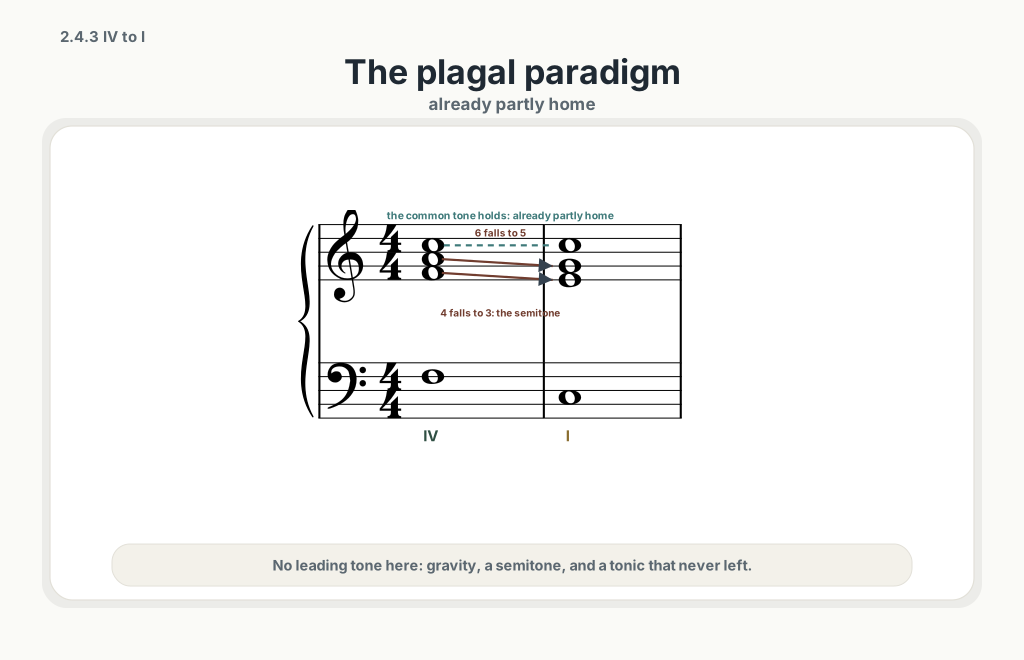
Here is what happens when IV moves to I. The root descends by a fourth (or ascends by a fifth) - the mirror image of V–I. There is no leading-tone pull; the subdominant does not contain the seventh degree of the scale. Instead, the resolution is governed by a different kind of voice leading: the fourth degree descends to the third (4̂–3̂), here is the crucial semitone resolution. The sixth degree may descend to the fifth (6̂–5̂); a gentler motion descending a whole step. The IV chord also shares a common tone with I (the tonic root itself is the fifth of the IV chord), and that shared note creates a feeling of overlap, of continuity, of already being partly home before you arrive.
solid line: the defining motion · dashed: supporting voice · gold: the common tone
The result is a resolution that feels softer, broader, more spacious. Where V–I slams the door with conviction, IV–I lets the door swing closed on its own. Where V–I commands, IV–I invites. Where V–I is the direct sea-route home, IV–I is the coastal journey - arriving at the same shore, but with a different quality of return.
Listen to Let It Be. The verse settles on a IV–I resolution, and the effect is not weakness - it is warmth. Acceptance. A settling-in rather than a locking-down. This is not an accident of songwriting. It is the Plagal Paradigm doing what it does best: creating closure that feels communal rather than authoritative.
Across many gospel styles, the Plagal Paradigm is a foundational grammar and often a primary mode of resolution - alongside dominant, blues, vamp, and chromatic practices. The “Amen” is not merely a decorative appendix: in plagal-rich passages, subdominant-to-tonic motion can make arrival feel warm, collective, and repeatable. Gospel harmony does not reject dominant pull; it places it within a larger vocabulary that also includes the subdominant’s embrace.
Listen to Coldplay’s Yellow, where the plagal motion is looped, cyclical, endlessly renewable - not a single moment of closure but a sustained state of arrival, a song that is always already home. Listen to Alicia Keys’s “If I Ain’t Got You,” where plagal resolution emerges from gospel piano textures with a naturalness that no V–I could replicate. Listen to the vast catalogue of modern R&B and indie pop built on I–V–vi–IV or its variants, where the IV chord resolves to I at the top of each loop, quietly and persistently confirming the key without ever invoking the dominant for that purpose.
The Plagal Paradigm is not an absence of dominant function. It is a different function - equally powerful, equally structural, equally capable of creating the sensation of arrival and rest. To hear it as a weaker V–I is to listen with the wrong ears. It is to parse English using only a German dictionary and wonder why the French words are not translating.
The Sage
“There are two roads to Ithaca. One cuts straight across the open sea - fast, forceful, certain. The other follows the coast, slower, taking the long way around. Both arrive. The journey changes the arriving.”
2.4.4The Dual Paradigms as Equal Forces
Here, then, is the defining thesis of this book’s approach to harmony:
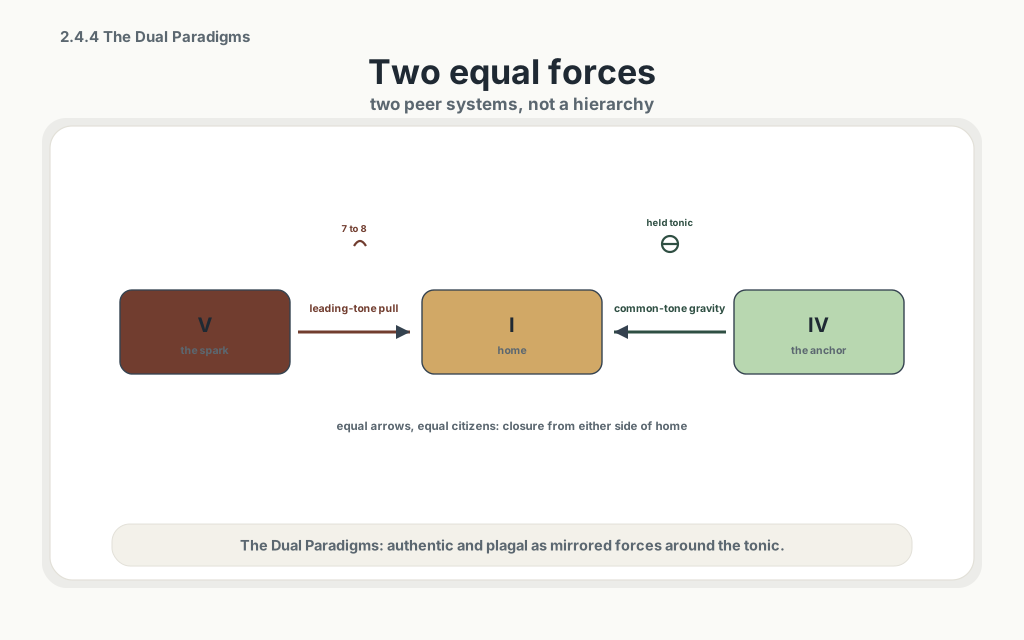
The Authentic Paradigm (V–I) and the Plagal Paradigm (IV–I) are dual, equal forces in popular music. Musical closure is a graded, style-dependent phenomenon - not a universal law dictated solely by dominant-tonic syntax. The V–I cadence is enormously powerful. It is not the whole story. And teaching it as though it were the whole story does a disservice both to the music and to the students trying to understand it.
In de Clercq and Temperley’s rock corpus (songs from 1954–2003), IV is the most common non-tonic root and the most common harmony immediately before tonic. In Temperley’s separate sectional-cadence count, however, V–I appears in 32% of songs and IV–I in 18.5%. The evidence strongly establishes IV–I as structural, not secondary. In many tracks across worship, ambient pop, lo-fi hip-hop, and neo-soul, dominant function is reduced or absent; those songs establish closure through other converging cues. The numbers refuse to crown a single king. The dominant still throws the hardest punch at the big cadential moments - but the subdominant owns the everyday roads home. A harmonic grammar with two ways of arriving is not a broken version of one with a single supreme cadence. It is a richer language, and popular music speaks it fluently.
What this means, practically, is that we must stop teaching the V–I cadence as the “real” ending and everything else as a deviation. Instead, we must teach two paradigms side by side, as dual aspects of a single phenomenon - the phenomenon of harmonic return.
V–I provides drive, tension, directional energy, and decisive closure. It is the sound of certainty.
IV–I provides space, breath, warmth, and a softer, often more modal sense of arrival. It is the sound of acceptance.
The greatest progressions in popular music often balance both. The I–IV–I–V loop - heard in Brown Eyed Girl, “The Lion Sleeps Tonight,” and a thousand others - alternates between plagal and authentic motion, swinging like a pendulum between warmth and drive, departure and return, gentleness and urgency. The I–IV–V–IV loop - the “Wild Thing” progression - uses the IV chord both to step away from the tonic and to step back down from the dominant, softening the V’s impact, triangulating between the three primary chords in an endlessly satisfying cycle.
Whether the harmony resolves through V–I or IV–I, the same allies strengthen the arrival: a melody landing on a stable degree, a rhythm landing on a strong beat. These are powerful cues rather than strict requirements - displaced, elided, and fadeout closures get by without them - but when they align, they outrank the harmonic paradigm itself. A plagal cadence that lands on the downbeat with the melody arriving on the tonic is more closural than an authentic cadence buried on a weak beat with the melody hanging on the second degree. The convergence of forces matters more than the identity of any single force.
We will build this argument - the argument about convergence, about the tripartite alignment of melody, harmony, and rhythm - piece by piece across the next two units, until it reaches its fullest expression in Chapter 4.8. For now, simply notice: the paradigm changes, but the principle does not.
Prof. Krankenhorn
“A cadence without a leading tone is like a sentence without a verb. It may convey a feeling, but it asserts nothing. I refuse to accept ‘Let It Be’ as a model of structural integrity.”
The Jester
“Professor, ‘Let It Be’ has been comforting people through grief for fifty years. How’s your structural integrity working out for you?”
2.4.5Diatonic Circle Progressions
The primary triads are the pillars. But there are four more diatonic chords in every key - the secondary triads, built on the second, third, sixth, and seventh degrees: ii, iii, vi, and vii°. And these chords, when set in motion by a specific principle, create some of the most propulsive harmonic sequences in all of music.
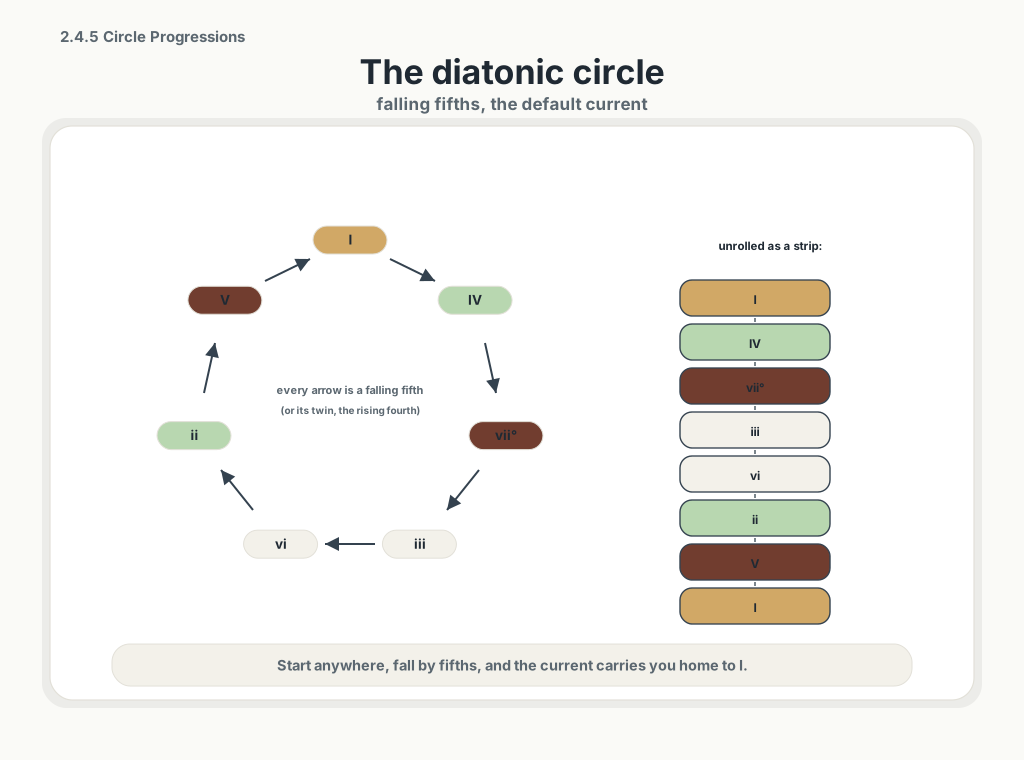
The principle is this: chords whose roots are a fifth apart share the same directional energy as V–I. When a chord’s root drops by a fifth (or rises by a fourth), the motion mimics the dominant-to-tonic relationship. It is not a true V–I - the chord qualities are different, the voice leading is different - but the root movement creates a similar sense of forward momentum, of inevitability, of one chord falling into the next.
Line up several of these falling-fifth motions in a row and you get a diatonic circle progression - a chain of chords cascading through the key by descending fifths. In C major: vi–ii–V–I. That is, Am–Dm–G–C. Each chord pushes into the next like a series of falling dominoes. The vi chord leans into the ii. The ii leans into the V. And the V, with the full force of the authentic paradigm behind it, leans into I. By the time you reach the tonic, you have been pushed there by three consecutive waves of forward motion. The effect is not just satisfying - it is inevitable.
Circle progressions are the engine of countless songs across genres. Gloria Gaynor’s I Will Survive rides a nearly complete circle of fifths with relentless momentum, turning the harmony itself into a survival march. Autumn Leaves - the jazz standard that has probably been played more times than any other - is built almost entirely on circle-of-fifths motion, its melancholy beauty arising from the way each chord surrenders to the next. Alicia Keys’s “If I Ain’t Got You” weaves gospel-inflected circle motion through a neo-soul texture, the falling fifths creating a sense of emotional accumulation - each chord carrying the weight of the last.
The circle progression is, in one sense, the ultimate extension of the Authentic Paradigm - every chord change is a miniature V–I, a chain of resolutions stretching backward from the tonic through the entire diatonic system. But notice what happens when the circle arrives at IV: it can resolve to I plagally, bypassing the dominant entirely. The circle progression, that most authentic of devices, can end with a plagal gesture. The two paradigms are not enemies. They are partners, and the circle is one of the places where they meet.
The Craftsman
“Play Am–Dm–G–C in the key of C. Now play it in G. Now in D. The chords change. The feeling doesn’t. That is what Roman numerals are for.”
Two paradigms. Two roads home. The question was never which one is right - it was how they work together. In the next chapter, we meet the schemata: the specific chord progressions that popular music has returned to, again and again, because they balance these dual forces in ways that never seem to get old.