1.2.1Notes, Pitch, Duration, Loudness, Timbre
Long before medieval Europe, musicians in many cultures devised ways to preserve musical knowledge. The monks in cold stone rooms belong to one later chapter in that older, cross-cultural history of notation, trying to remember what they had sung last Tuesday.
That is not entirely a joke. The history of musical notation is partly the history of memory’s limitations. For much of human history, most music travelled chiefly by oral transmission - from teacher to student, elder to congregation - even as many cultures also developed systems for marking parts of it down. As notational systems appeared in different cultures, one of their recurring purposes was memory: preserving and transmitting music beyond a single performance. The Latin word nota - a mark, a sign - tells part of the story. Notation marks music down so it can be remembered, taught, studied, shaped, and shared.
We have come a long way from those monks. The system of notation used today can communicate extraordinarily precise information about what to play, when to play it, and how long to hold it. But it is worth remembering - and we will return to this idea throughout the book - that notation was designed to serve certain kinds of music, and it serves some kinds better than others. It is very good at telling a pianist which keys to press and for how long. It is less good at capturing what happens when a guitarist bends a string, or a vocalist slides between pitches, or a producer layers six tracks of subtly different timbres to create a sound that no notation system was ever designed to represent.
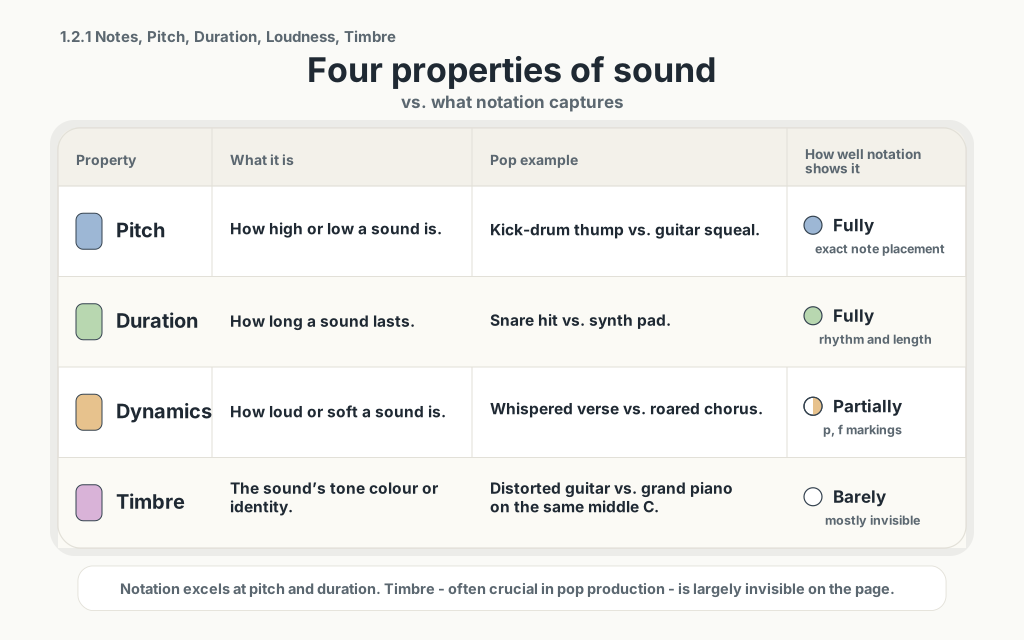
Every musical sound has four primary characteristics, and understanding them will help you hear the difference between what notation can capture and what it suggests.
Pitch is how high or low a sound is - the high squeal of a guitar harmonic versus the low thump of a kick drum. Duration is how long it lasts - a quick snare hit versus a long, sustained synthesizer pad that washes across an entire verse. Dynamics describe how loud or soft the sound is - the whispered vocal of an intimate verse versus the full-throated roar of a rock chorus. And timbre (pronounced TAM-ber) is the quality that allows you to tell instruments apart even when they play the same note at the same volume for the same length of time. A distorted electric guitar playing middle C sounds nothing like a flute playing the same middle C. The pitch is identical. The timbre is not.
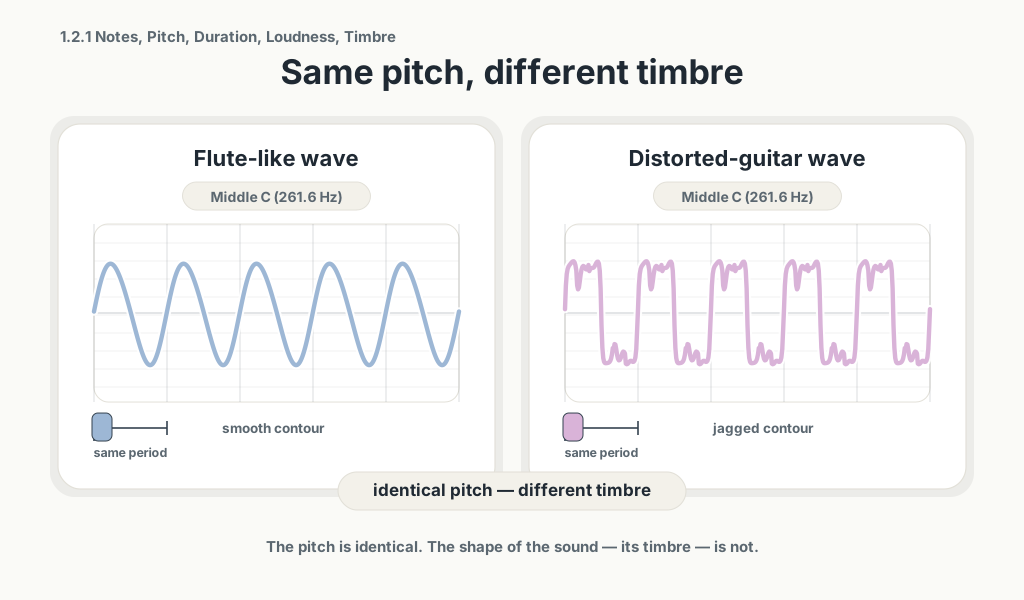
Standard notation is primarily designed to communicate the first two: pitch and duration. Dynamics get their own markings - piano, forte, and the spectrum between - but timbre, the thing that often matters most in popular music production, is largely invisible on the page. Think about that for a moment. The characteristic that distinguishes a Billie Eilish track from a Metallica track - the sonic texture, the layered production, the careful choice of which instrument plays which part - is the one thing notation struggles to show you. A producer building a mix in a DAW is sculpting timbre with surgical precision, and yet if you transcribed the result onto staff paper, most of that information would vanish.
This is not a flaw in notation. It is a reminder that notation is a tool, and like all tools, it was built for a particular purpose. We will learn to read it fluently, because it remains the universal language for communicating musical ideas across instruments and traditions. But we will also learn to listen past it - to hear the dimensions that live beyond the page.
1.2.2The Staff, Clefs, Ledger Lines
To represent pitch on paper, we use a staff (plural: staves - one of those words, like “octave” and “clef,” that English borrowed from other languages and never gave back). The staff consists of five parallel horizontal lines and the four spaces between them. Notes are placed on these lines and in these spaces, and the simple rule is: higher on the staff means higher in pitch.
But a staff by itself is a blank grid. Five lines and four spaces give us nine positions, and without further instructions, we have no idea which nine pitches they represent. This is where the clef enters - from the French clef, meaning “key.” A clef is the key that unlocks the staff, assigning a specific pitch to a specific line so that every other position falls into place.
The two clefs you will encounter most often in popular music are the treble clef and the bass clef.
The treble clef - also called the G clef, because its ornate spiral curls around the second line from the bottom and declares it to be G - is used for higher-pitched instruments and voices: guitar, flute, violin, the right hand of the piano, and most vocal parts. The bass clef - the F clef, because its two dots bracket the second line from the top and declare it to be F - handles the lower end: bass guitar, cello, trombone, the left hand of the piano.
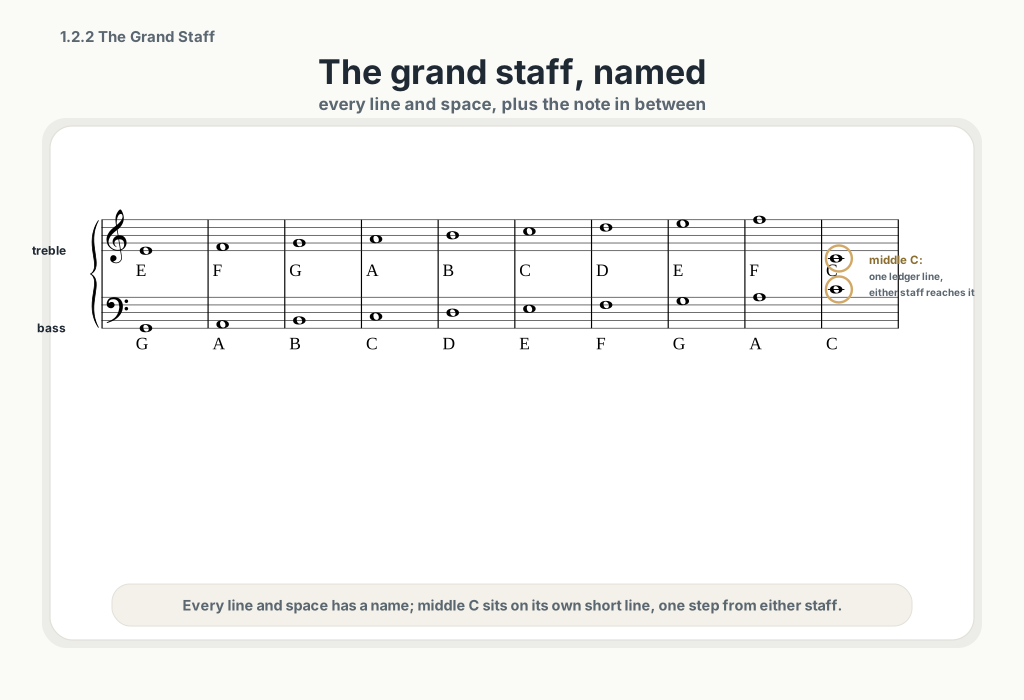
When these two clefs are stacked together, joined by a brace and connected by a single barline, they form the grand staff. The grand staff is what pianists read every day - treble on top for the right hand, bass on the bottom for the left - and it gives us a panoramic view of pitch from very low to very high. One pitch sits exactly between the two staves, on its own tiny ledger line: middle C. It is the meeting point, the handshake between treble and bass, and you will see it so often that it will become an old friend.
And that brings us to ledger lines. Five lines and four spaces is a generous range, but music does not always stay within bounds. When a melody climbs above the treble staff or a bass line drops below the bass staff, we extend the system with short, temporary lines drawn above or below. These are ledger lines - little planks laid out into the air, one at a time, as the music needs them. Three or four ledger lines above or below a staff are common. More than that starts to become difficult to read, which is why we have a shortcut - but we will get to that in a moment.
1.2.38va and 8vb
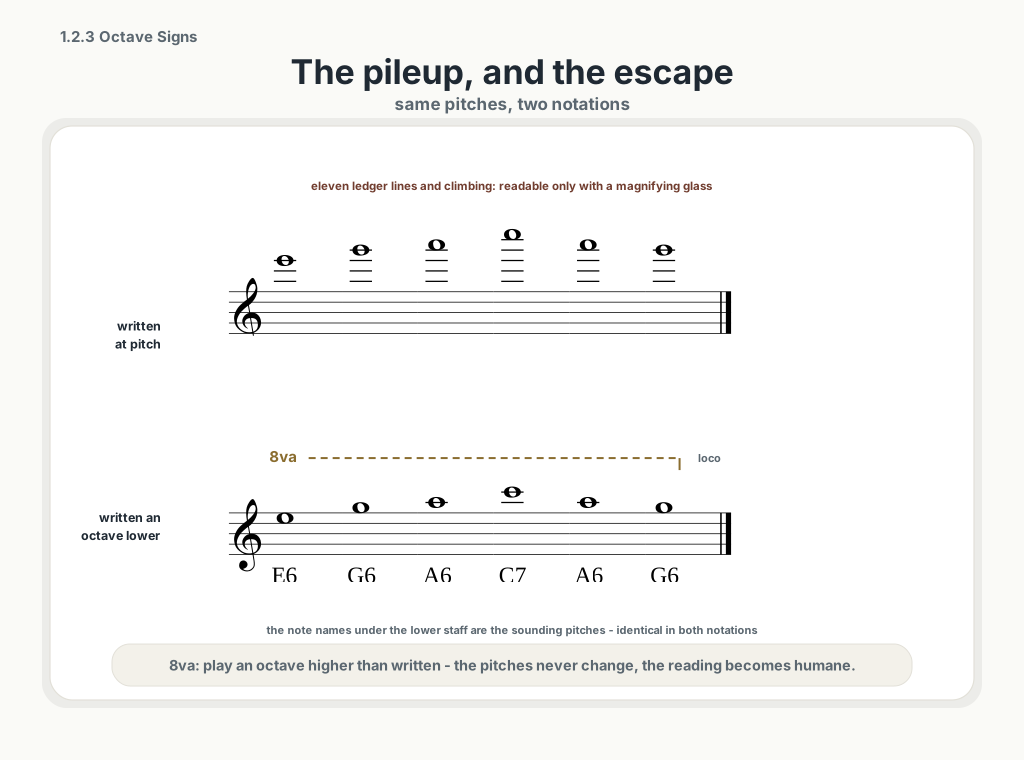
Imagine a guitar solo that ventures six ledger lines above the treble staff. Every note is perched on its own tiny plank, the spacing is cramped, and the player squints at the page trying to count lines while the band plays on. There is a better way.
The symbols 8va and 8vb exist to rescue us from ledger-line pileups. They are abbreviations of the Italian: ottava alta (at the octave above) and ottava bassa (at the octave below). When you see 8va written above a passage, it means: play everything one octave higher than written. The notes on the page stay comfortably within the staff, but the sound comes out an octave up. When you see 8vb written below a passage, the reverse applies - play one octave lower than written.
A dotted line extends from the symbol to show exactly which notes are affected, and the word loco (“in place”) appears where the transposition ends, telling the player: go back to reading at pitch.
These symbols are especially common for instruments with wide ranges - piano, guitar, bass - and for any passage that would otherwise require a forest of ledger lines. They are a notation convenience, nothing more. The music is the same whether you write it on ledger lines or with an 8va bracket. But readability matters. A performer reading fluently will always play better than a performer counting ledger lines in a panic. Good notation, like good writing, serves the reader.
The Craftsman
“Write it so the player can read it at tempo. If they have to stop and count, you have failed - not them.”
The page is a map, not the territory. Learn to read the map, but never forget: the music lives in the air.