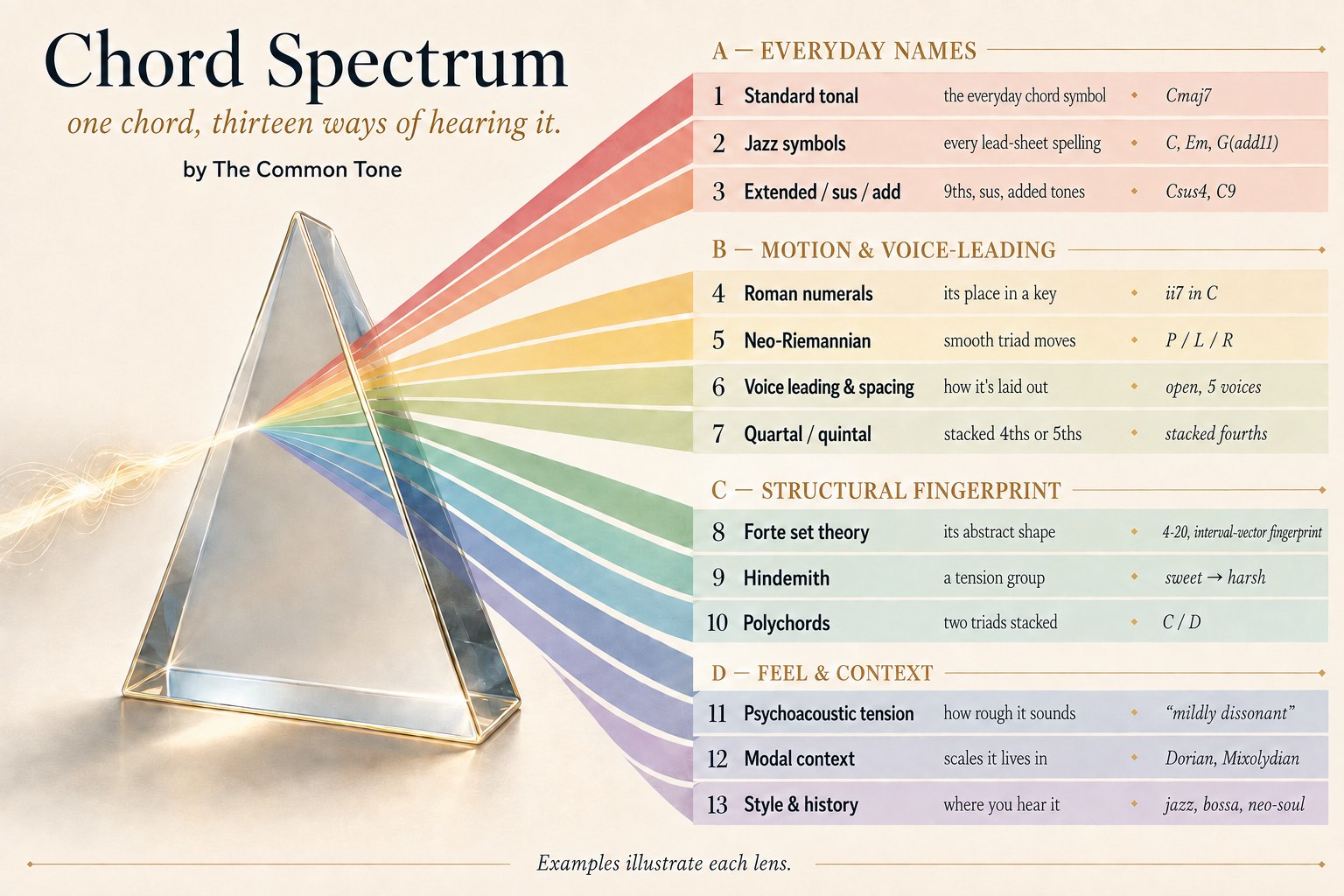
One chord in; thirteen readings out. The prism invents nothing — it separates what was already there.
Chord Spectrum answers one question — what is this chord? — in more ways than most people know exist. This page walks through every part of what it tells you, in plain language, and points you somewhere trustworthy to read more. You don't need any of it to enjoy the tool; treat this as a map you can consult whenever a word on the screen makes you curious.
Nothing here is required reading. Play a chord first, then come back and look up whatever caught your eye.
Piano playback and sound help
Listen plays your entered notes together; Arpeggio plays them in order and holds the completed chord before releasing it. Stop appears beside these buttons during playback or loading.
The sound is Splendid Grand piano recordings (public-domain AKAI samples; kinwie mapping). Notes outside A0–C8 use explicitly labelled basic tones to preserve the pitches you entered.
If you hear nothing, check your output volume; on iPhone, try Silent Mode off. If recordings cannot load, use Retry sound. Sample source and credits.
Getting a chord in
There are two ways to hand Chord Spectrum a chord. You can play the on-screen piano, or you can type note names into the box — something like C4 E4 G4 B4, where the number is the octave. Any chord from two to twelve notes works.
One control is easy to miss and matters more than it looks: double-click a black key to flip how it's spelled — G♯ becomes A♭ and back. Those are the same key on a piano but not the same note on paper, and the spelling changes the reading. The very same keys can be a ♯5 in one spelling and a ♭13 in another. Chord Spectrum respects the spelling you choose.
Every chord also gets its own link — add ?notes=C4,E4,G4 to the address, or &lens=forte to open a particular reading first. Nothing is saved and nothing is tracked.
The answer
The answer starts with the strongest complete identification available: a complete Messiaen collection, a supported named sonority, a spelling-matched classical possibility, or an ordinary chord symbol. Contextual readings keep their qualifications. The entered notation and listening controls sit beside that answer.
For example, all ten notes of Messiaen Mode 7 lead with that name, rather than a partial jazz symbol or an unexplained set-class number. Open Other readings and technical details for alternative interpretations, missing-note evidence, prime forms, symmetry and tension scores. The Examples menu groups familiar chords, named sonorities, collections and Messiaen’s modes.
NameThe common label — Cmaj7, Am, G7 — its root and its quality.
InversionWhich note is on the bottom. A C-major chord with C in the bass is “root position”; with E in the bass it's “first inversion.” Same chord, different footing.
A historical name can tell you something a chord symbol leaves out. These cards appear alongside the ordinary analysis when the notes match one of the supported examples. A pitch match does not identify the composer or prove how the chord functions in a passage.
Tristan-related spelling. F–B–D♯–G♯ has the pitch classes of a half-diminished seventh, but a different spelling. The card requires that written interval pattern, allowing transposition and revoicing; an ordinarily spelled Fø7 does not trigger it. One contextual reading hears G♯ move to A, producing F–A–B–D♯, a French sixth in A minor. The isolated opening chord does not establish that motion, and this is one interpretation among several.
Mystic / Prometheus. C–F♯–B♭–E–A–D matches Scriabin’s six-note mystic chord. Its familiar arrangement stacks fourths of different sizes. The tool accepts transpositions and other voicings, but not every inversionally related pitch-class set. A jazz reading such as C13(♯11) can coexist with this historical association.
Petrushka. C–E–G together with F♯–A♯–C♯ combines two major triads a tritone apart. The card names both triads without inferring two established keys. These six notes also fit inside an octatonic collection; expand the partial collection matches to see the two missing notes.
Messiaen’s seven modes of limited transposition are pitch collections whose internal repetition means that some transpositions produce the same notes again. Mode 1 is the whole-tone collection; Mode 2 is octatonic. There are two distinct transpositions of Mode 1, three of Mode 2, four of Mode 3, and six each of Modes 4–7.
Complete collection means every pitch class in that mode is present, with no extra notes. Doublings and octave placement do not change this match. Subset only means all your notes belong to a larger collection: the card lists its full contents and the notes you have not entered. Containment is a possible resource for exploration, not evidence that a piece uses that mode.
Transposition 1 uses the conventional C-based first form. Each following number raises that form by one semitone, stopping before the same collection repeats. These are collection labels, not keys: the first displayed pitch does not assert a tonic. Equivalent rotations appear only once per mode and transposition.
Choose a mode from the Examples menu to enter its complete first form. Guided view keeps supporting analysis under Other readings and technical details; Everything open expands it, including partial collection matches. Small chords fit many collections, so fewer missing notes means a closer pitch match, not a more certain interpretation.
Here is the idea that makes Chord Spectrum different from an ordinary chord-namer. A chord doesn't have one true description — it has many, all correct at once. So instead of picking one, the tool shows you thirteen, and ranks them by how much each one actually tells you about the chord in front of you. It's the prism sorting its colours: the brightest, most revealing band goes to the front; the readings that add little get tucked to the side, each with a one-line reason for where it sits.
A plain C-major triad, for instance, fits many keys, so its Roman-numeral possibilities sit lower in the supporting analysis. A collection with no complete chord name benefits from its set-theory fingerprint. Two views let you choose how much to see: Guided shows the compact answer with expandable supporting readings; Everything open opens the supporting analysis and all thirteen lenses.
It won't fake an answer. If a name only half-fits — say a chord symbol that leaves one note unexplained — the tool says so, and marks the match as partial rather than pretending it's clean. Honesty about what a reading can't tell you is part of the point.
Group A
The everyday names
What a working musician would actually call the chord — the labels you'd write on a lead sheet or say out loud at a rehearsal.
1 Standard tonal
The ordinary chord symbol and everything packed into it: the root (the note it's named for), the quality (major, minor, diminished, augmented, seventh…), and the inversion.
On screenThe symbol, root, bass note, quality, inversion, and a “coverage” note saying whether every note you played is accounted for.
ExamplePlay C–E–G–B and you get Cmaj7, root position, all four notes matched — a complete reading.
Classical readingsItalian, French, German and enharmonic German sixths appear beside the chord-symbol answer. A♭–C–D–F♯ matches a French sixth in C: ♭6̂–1̂–2̂–♯4̂. The same pitches can also read as a French sixth in F♯, spelled D–F♯–G♯–B♯. Each suggested respelling is shown explicitly; your entered notes stay on the staff. These are possible interpretations, whose function depends on key and voice leading.
The same notes as a jazz or pop musician might write them — often several defensible ways at once, because lead-sheet spelling is a language of shorthand and choice.
On screenA list of every reasonable lead-sheet name for the notes, from the plainest to the most colourful.
ExampleCmaj7 accounts for all four notes of C–E–G–B. C major and E minor are contained triads; neither alone names the whole chord. For A♭–C–F♯, the jazz reading A♭7(no5) uses G♭ as its seventh; the entered F♯ supports the Italian-sixth interpretation.
Chords that reach past the basic triad — ninths, elevenths, thirteenths — plus the “suspended” chords that swap the third for a nearby second or fourth, and “add” chords that drop an extra note in.
On screenAny extended, suspended, or added-note names the notes support.
ExampleC–F–G reads as Csus4 (and Fsus2); adding a D to a C7 gives C(9).
Not what the chord is in isolation, but how it sits, where it might go, and how it connects to its neighbours.
4 Roman numerals
A chord's address within a key. Where a chord symbol tells you what the chord is, a Roman numeral tells you where it lives and why it might move — the same I–IV–V grammar in every key.
On screenThe chord read as a numeral in each key it could belong to, major and minor.
ExampleA D–F–A–C seventh chord shows up as ii7 in C, i7 in D minor, vi7 in F, and more — one chord, many roles.
A way of describing how one triad glides to another by moving a single voice a step or a half-step. Three basic moves — P, L, and R — connect major and minor triads in the smooth, surprising ways you hear in film scores and late-Romantic music.
On screenFor a plain major or minor triad, the three neighbouring triads a P, L, or R move away. (It only applies to triads, and says so when it doesn't.)
ExampleFrom C minor: P → C major, L → A♭ major, R → E♭ major.
ScholarlyDavid Lewin, Generalized Musical Intervals and Transformations (1987); Richard Cohn, Audacious Euphony (2012).
Not the chord's name but its layout: how far apart the notes sit, whether it's bunched up or spread out, and whether any note is doubled. Spacing is a big part of why two chords with the same name can sound completely different.
On screenThe spacing (close or open), the total span, the number of voices, the average gap between them, and any doubled notes. The notation, Listen and Arpeggio preserve your entered notes and registers.
Most chords are built by stacking thirds. These are built by stacking fourths (quartal) or fifths (quintal) instead — the open, modern, slightly unmoored sound of a lot of jazz piano and film music.
On screenWhether the notes stack in fourths or fifths, and a short description when they do.
ExampleC–F–B♭–E♭ reads as “quartal harmony — stacked perfect fourths.”
Ways of describing a chord that ignore keys and styles entirely and look only at its raw shape — most useful for chords too strange for an ordinary name.
8 Forte set theory
A method for naming any collection of notes by its abstract shape, invented to handle music that doesn't play by tonal rules. Every possible chord gets a catalogue number and a compact “fingerprint,” regardless of key or spelling.
On screenThe set-class name, its prime form (the shape reduced to its tightest packing), the interval vector (a tally of every interval inside it), and any symmetry the chord has.
ExampleThe whole-tone six-note chord is 6-35, prime form (0,2,4,6,8,10), and “transpositionally symmetrical” — the honest name for a chord no tidy symbol fits.
ScholarlyAllen Forte, The Structure of Atonal Music (Yale, 1973).
The composer Paul Hindemith built his own system that sorts every chord into groups by how tense it is and whether it contains the restless tritone — a single ladder of tension from sweet to harsh, with a clear “root” for chords that tonal theory leaves ambiguous.
On screenThe chord's Hindemith group (his categories run from simple, tritone-free consonance to sharp, indeterminate dissonance).
ExampleA plain major triad lands in his most consonant group; a chord built around a tritone lands in a tenser one.
ScholarlyPaul Hindemith, The Craft of Musical Composition, Vol. 1 (1937/1942).
A chord heard as two simpler chords stacked on top of each other — one triad riding above another. It's how a thick, ambiguous sonority often makes the most sense: not one exotic chord, but two familiar ones at once.
On screenAny way the notes split into two stacked triads, written in “upper / lower” slash form.
ExampleC–E–G–D–F♯–A reads as C/D — a C triad over a D triad — among other stackings.
Less about structure, more about the chord's character: how rough or smooth it sounds, which scales it lives inside, and where you'd actually meet it in the wild.
11 Psychoacoustic tension
A measure of how rough the chord sounds to the ear — not whether the theory calls it a dissonance, but the physical grind produced when close-together tones beat against one another. It's consonance and dissonance measured as sensation rather than rule.
On screenA roughness score and a plain label, from “Consonant” to “Dissonant.”
ExampleA minor triad reads “Consonant” (about 0.20); a major seventh “Mildly Dissonant” (0.32); a whole-tone cluster “Dissonant” (0.52).
ScholarlyPlomp & Levelt, “Tonal Consonance and Critical Bandwidth” (1965).
Which scales and modes the chord fits inside. A single chord can belong to many scales at once, and knowing which ones is how improvisers decide what to play over it.
On screenA list of the scales and modes that contain all the chord's notes.
ExampleA D-minor seventh chord shows up as fitting C Ionian (major), D Dorian, G Mixolydian, and others.