Companion to Chapter 1.8, Powerful Chords and More
Iron Man
The Power Chord Industrial Complex
Douglas Gwynn Smith
There are no hidden keys, only disputed ones.
The basement
Oh man, I must have been about fourteen or something when I first heard that. I was in the basement at my bandmate’s house. I think I was playing guitar in that band. I have to say that for a young kid, like I was, without much scale knowledge on the guitar or anything, it was actually pretty appealing. If you could hold your two fingers together to form the fifth and you could slide up and down with rhythm, then you could pull off something like “Iron Man”. If you had a bit of fuzz on your guitar, it would sound pretty darn cool.
A machine made of iron
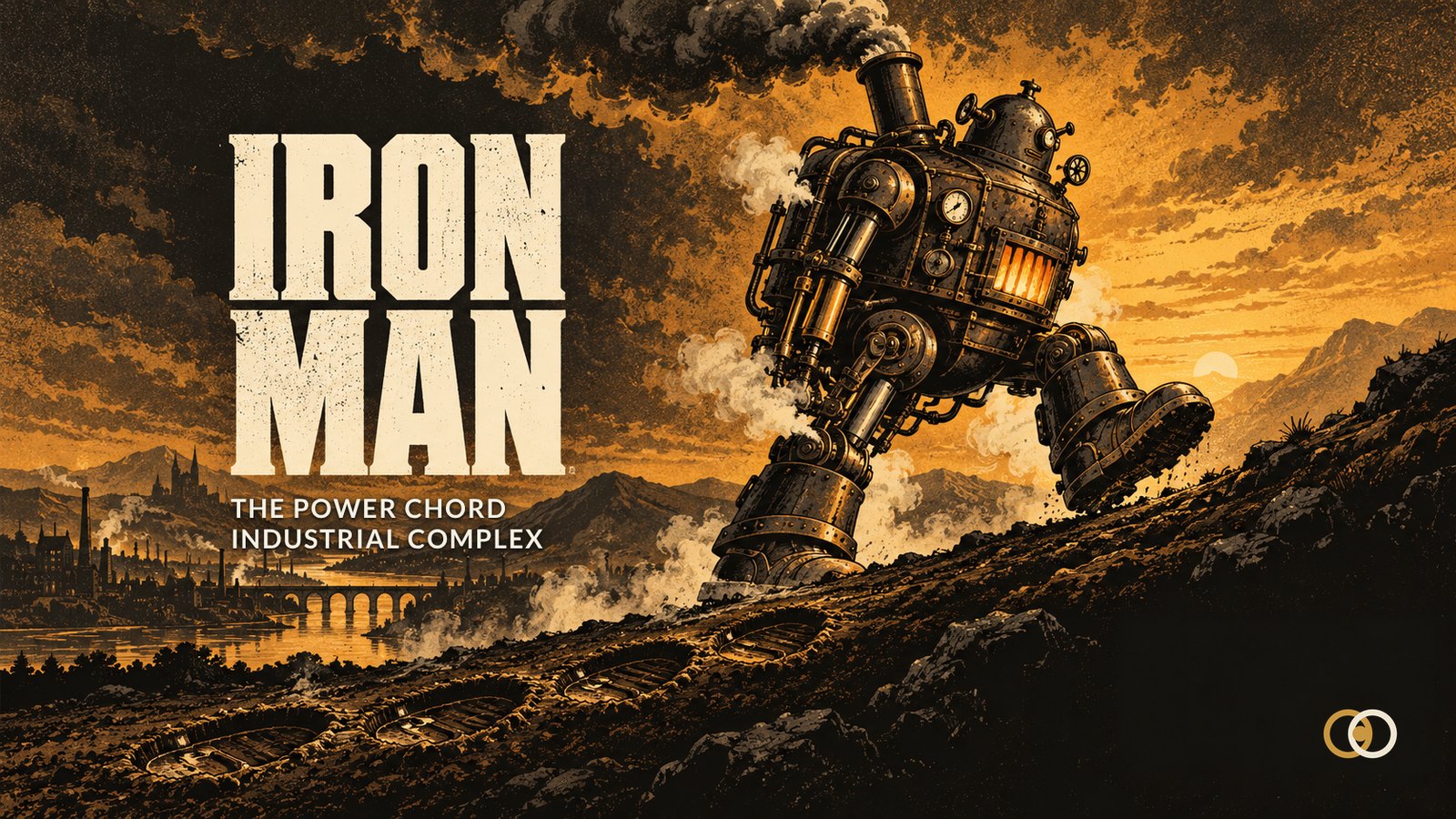
And to bounce to the other end of the spectrum, it’s interesting how the effect of having heard it for decades opens up new vistas. I hear it more and more as being what the title implies: an Iron Man, maybe a steampunk kind of Iron Man. What it truly is is a mechanical device. You can imagine the gait of this creature, because it starts out with effort, effort, effort, effort, and only finally achieves the goal of getting to the tonic on a very late, weak beat of the phrase. Then it has to start all over again. It reminds me very much of watching a steam engine start up and gather enough steam and force that it can make one revolution, and then do it again and make another revolution.
I suppose that makes sense, because it hasn’t arrived at home. Who knows where it is until you arrive? You know you’re on a journey, and you’ve got all that uphill energy and pushing of these power chords until you finally get there. You’re so exhausted, you let go, and you’re — boom — back at the bottom of the scale again.
The arrival on E is a weak beat — a weak beat at the very end of a two-bar phrase. But when I sing the note, there’s no other pitch that could act like a tonic. There’s no other centre where you could just, at least, stand in a neutral way. All the other notes have energy and motion built into them, and you can hear that only at the very end of this machine-like cycle. This machine might be made of iron. Oh, now there’s a thought.
No hidden keys
I want to say something deep and profound, like, “There are no hidden keys, only disputed ones.” That actually sounds pretty good. I might be a great statesman in the nineteenth century. Politics aside, however, I don’t hear a hidden key here. I don’t really hear it as sections which are not related, but they differ in the overall modal construction and they’re quite contrasting. I’m not sure if they really earned the sobriquet of “key” in the more traditional sense of tonality. It’s as if I hear the song like a functioning airplane — one that had been put together from the remains of several other airplanes — and it creates a unique functioning and quite fascinating type of musical contraption. And of course, this is new rock music. It doesn’t follow the rules of older tonal systems, and why should it?
Because — where is the direction, the energy, and the power of this going to? It’s all driving to that final note of the riff, and we know we’ve arrived.
A foot in both worlds
The power chord lacks a third, the very thing that tints our tonality, so how do we know this riff is minor? Well, I know because I’ve listened to it and played it, and I know what the scale structure is that surrounds it. If E is the tonic, it’s most certainly in a minor modal scale world.
It’s probably also kind of important to know that power chords aren’t typical full-blown harmonies for a song. They are more than a line; they’re more than a counterpoint or a bass line, because they’re doubled and often highly amplified. So they have a less bass-like existence and a more texture-like existence, but they really have a foot in both worlds. This is part of the charm of the texture of music using power chords. You definitely want to listen to the riff and the melodies the singers are singing, because these will colour an otherwise somewhat austere type of musical texture. And I repeat: this is a feature, not a bug.
The note that stayed
Something did stay with me very clearly, and I began to hear more of what would come to be known as metal music in the future. Metal has never really been my bag, though I’ve never particularly disliked it, but its presence definitely stayed with me. And of course, it never came out of a vacuum either; it’s part of a long tradition of blues and rock and blues, and all that crazy stuff that was coming out of the 1960s.
An actual note? It was more of the presence that stayed with me than a note. But as an ever-analytical youngster, I definitely noted the minor pentatonic skeleton of this song, and noted it because I was always the observer, and still am.
And if you really want notes, then it would be the opening of the Black Sabbath song “Black Sabbath”, which starts on the tonic, leaps the octave, and drops to the tritone below, and then back up to the tonic, and so on and so forth. It’s that song that really struck me more deeply, in that interval — so not one single note — and it probably had more effect on me than “Iron Man”, because there were already riff-type songs out there.
This piece is a companion to Chapter 1.8, “Powerful Chords and More.” The chapter is about the chord itself — two notes, the fifth, and why distortion loves it — and traces it from the Kinks through Black Sabbath to Nirvana.
→ Read Chapter 1.8, “Powerful Chords and More”
→ Try the activities
First published on Substack, 28 October 2026. This is the site’s archive copy.